
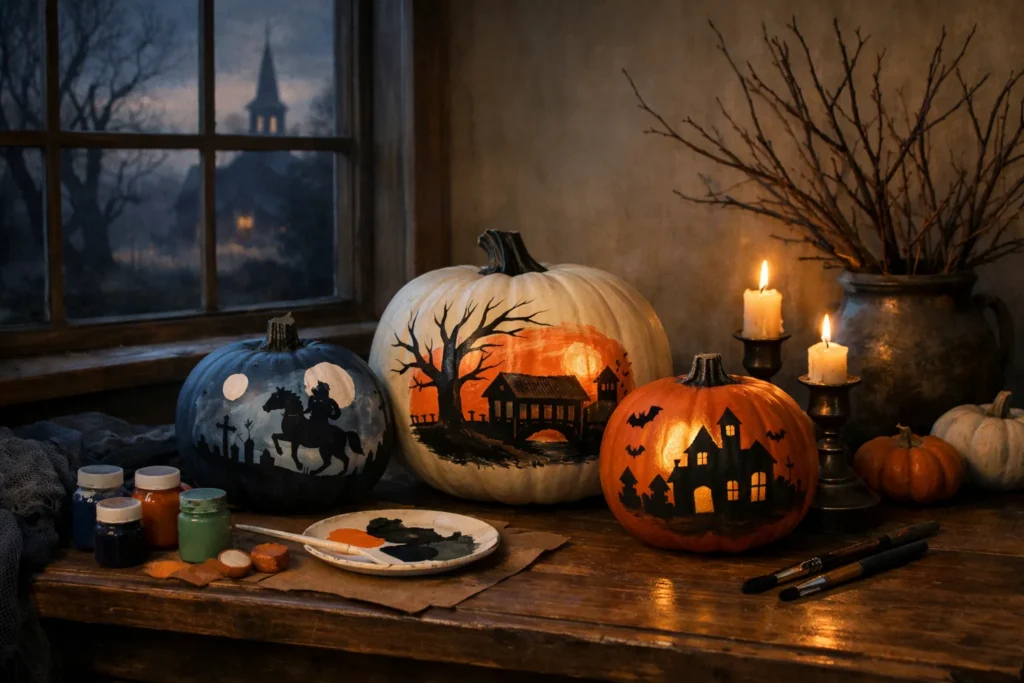
Sleepy Hollow, New York, is forever tied to Washington Irving, whose 1820 story “The Legend of Sleepy Hollow” gave American fall its headless horseman and its jack-o’-lantern atmosphere. You do not need a carving knife to join in. Painted pumpkins are safer for children, last longer on the porch, and let everyone make exactly the face or scene they have in mind.
Pick the right pumpkins
Small and medium pumpkins, about 4 to 8 inches (10 to 20 cm) across, are easiest to handle. Look for firm skin with no soft spots and a sturdy stem. Smooth pumpkins take paint better than deeply ribbed ones. If you buy them from a farm stand, ask when they were picked; fresher pumpkins stay firm longer.
Wash each pumpkin with a damp cloth to remove dirt, then let it dry thoroughly. Do not use soap and water that soaks into the stem.
Gather the supplies
- Acrylic craft paint in black, white, orange, purple, and green
- Flat and round brushes, plus a few cotton swabs for dots
- Pencil for sketching the design
- Paper plates for palettes and newspaper to cover the table
- Clear acrylic spray sealer, used outdoors by an adult
Choose paints that carry the ACMI seal on the label, and have kids wear old clothes. Acrylic does not wash out of fabric once it dries.
Four easy Sleepy Hollow designs
- Headless horseman silhouette. Paint the whole pumpkin orange, then add a black horse and rider with a lantern raised on one side. A dark purple sky behind them sets the mood.
- Ghost pumpkin. Cover the pumpkin in two coats of white. Add black oval eyes and a round mouth. This one is the most forgiving for small hands.
- Full-moon pumpkin. Paint the surface deep blue, then dab pale yellow circles for the moon and a bare tree branch in black.
- Pumpkin patch pattern. Make a polka-dot or stripe design in autumn colors, with no scenery needed.
Paint in layers
Light colors over dark ones take extra coats, so start with the lightest base color and work toward details. Wait about 20 to 30 minutes between coats. Use a pencil to sketch faces lightly before painting, which also helps younger kids who like to see where the lines should go.
Younger children can press hand or fingertip prints for ghosts, owls, and spiders. Keep a bowl of water and a stack of paper towels nearby, and lay a wipe-down mat under the whole project.
Seal it and keep it fresh
Once the paint is fully dry, spray on a light coat of clear sealer. This protects the design from damp porch air. A painted pumpkin kept in a cool, dry place away from direct sun can look good for about three to four weeks, though how long depends on temperature and how fresh it was when you bought it. Throw it out once it gets soft or leaks.
For another fall project that uses paper instead of paint, see the paper crafts and printables section. And if you would like background reading on Irving’s tale, the Wikipedia entry for the story is a short, easy start.