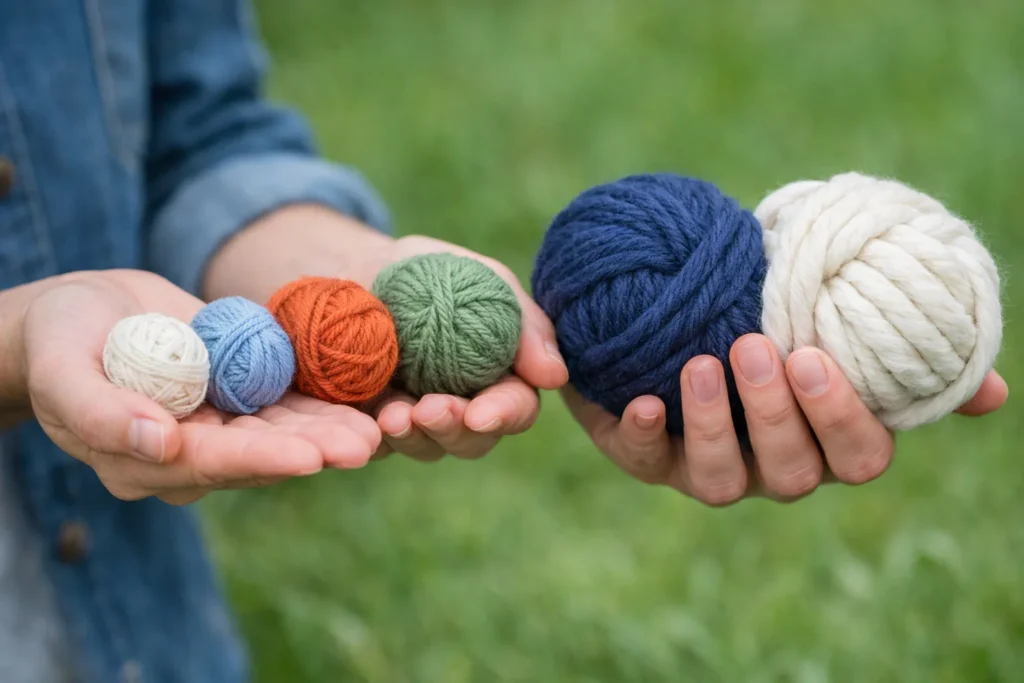
Walk into a yarn shop and the labels all seem to say something different: lace, sport, worsted, bulky. Underneath the names there is a simple scale. The Craft Yarn Council publishes the Yarn Standards, a numbered system from 0 to 7 that many American yarn makers print on their labels as a small skein symbol with a number inside.
That number describes how thick the strand is, and thickness decides the hook or needle you use, how fast a project grows, and how it will drape. Here is the whole scale in one place.
The seven categories at a glance
The hook sizes below are typical suggestions for crochet. They are a starting point, and your own hands may call for one size up or down. Always check the label of the yarn you are holding.
| Weight number | Name | Hook size | Typical projects |
|---|---|---|---|
| 0 | Lace | Steel hooks, about 1.6 to 1.4 mm | Doilies, fine shawls, delicate edgings |
| 1 | Super fine | 2.25 to 3.5 mm | Socks, baby items, lightweight shawls |
| 2 | Fine | 3.5 to 4.5 mm | Light sweaters, scarves, baby blankets |
| 3 | Light | 4.5 to 5.5 mm | Cardigans, summer tops, toys |
| 4 | Medium | 5.5 to 6.5 mm | Afghans, hats, mittens, everyday sweaters |
| 5 | Bulky | 6.5 to 9 mm | Chunky scarves, rugs, warm winter hats |
| 6 | Super bulky | 9 to 15 mm | Quick blankets, thick cowls, throws |
| 7 | Jumbo | 15 mm and larger | Arm-knit blankets, floor poufs, big statement pieces |
What the names really mean
Names such as worsted, DK, and fingering are common in shops and patterns, but they are not always precise. A yarn sold as worsted can land in category 3 or 4 depending on the maker. The number is more reliable than the name, so when a pattern asks for a weight, match the number first and use the name as a hint.
Fiber also changes how a weight behaves. A cotton in category 4 feels heavier and less stretchy than a wool in category 4, and a yarn with a lot of fuzz can look thicker than it is. This is why swatching matters, whatever the label says.
When you can substitute one yarn for another
Substituting is common, especially when a pattern calls for a yarn that is hard to find or too expensive. A safe swap follows a short checklist.
- Match the weight number, and then compare the gauge printed on both labels.
- Match the fiber family, so a wool pattern gets a wool or wool blend if the garment needs to keep its shape.
- Check the yardage, not the ball weight. Two balls of 100 grams can hold very different lengths of yarn.
- Make a swatch, wash it, and measure it again.
Yardage is the number that surprises people most. A pattern may ask for 1,200 yards (about 1,100 m), and if your yarn has 180 yards (165 m) per skein you need seven skeins, not five. Divide the total by the yardage per skein and round up.
Choosing a weight for your project
If you are a beginner, categories 4 and 5 are the easiest to see and handle. Stitches are large enough to count, and a project grows fast enough to keep you motivated. Lace and super fine yarns look beautiful but ask for patience and good light.
Think about the finished object as well. A baby blanket that will be washed often does well in a smooth category 3 or 4 yarn that can handle a machine cycle. A winter hat wants the warmth of a category 4 or 5 wool blend. A statement rug or basket works best in a sturdy category 5 or 6 cotton or jute blend that holds its shape.
Finally, remember that a heavier yarn is not always faster for a new crocheter. Very thick yarn can be hard on the wrists, and giant hooks feel awkward. A medium weight in a light color, where you can see each stitch, is usually the kindest first choice.