

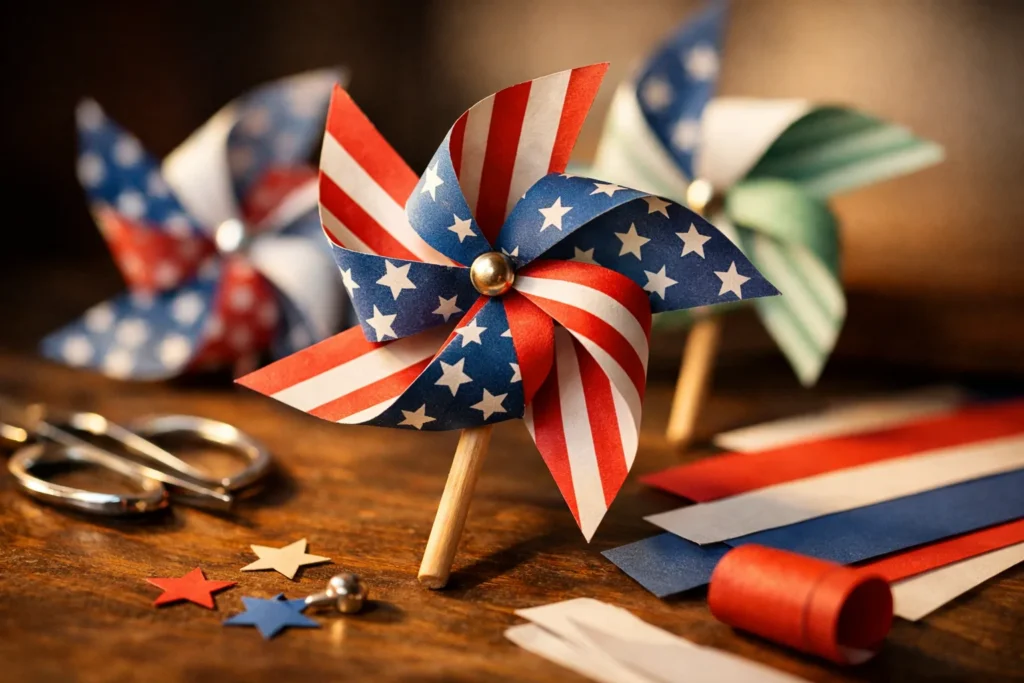
Bristol, Rhode Island, is known for hosting one of the oldest Fourth of July parades in the country, a tradition that dates back to the 1780s. Kids line the route with flags and noisemakers, and a handmade pinwheel fits right in. Here is a quick version that works for a crowd.
What you need
- Square sheets of lightweight cardstock or origami paper, 6 inches (15 cm) per side
- A paper straw or a wooden dowel
- One paper fastener (brad) or a pushpin for each pinwheel
- Scissors, a ruler, and a pencil
- Red, white, and blue paper, markers, or stickers for decoration
Steps
- Decorate both sides of the square first, since you will not reach them later.
- Draw light diagonal lines from corner to corner so they cross in the center.
- Cut along each diagonal, stopping about an inch (2.5 cm) before the center. Leave the middle uncut.
- Pick up one corner and fold it gently to the center, without creasing it. Do this for every other corner, so you use four of the eight points.
- Hold the stack with your thumb, push the brad through all four folded points and the center, then through a bead if you have one.
- Attach the pinwheel to the straw by pushing the brad through the straw an inch from the top and opening its legs. An adult should handle the pushpin if you use one.
Blow on it to test. If it does not spin, loosen the brad slightly so there is room to turn.
Safety around little ones
Pushpins, brads, and small beads are choking and poking hazards for toddlers. The Consumer Product Safety Commission warns that small parts are dangerous for children under three, so make these for school-age kids and keep the fasteners away from babies. For a parade, ask children to carry the pinwheel with the straw pointing up and to stay out of the street.
A pinwheel is also a good first project for practicing careful folding. Try a second one with patterned scrapbook paper, and compare how the thicker sheet spins in the same breeze.