
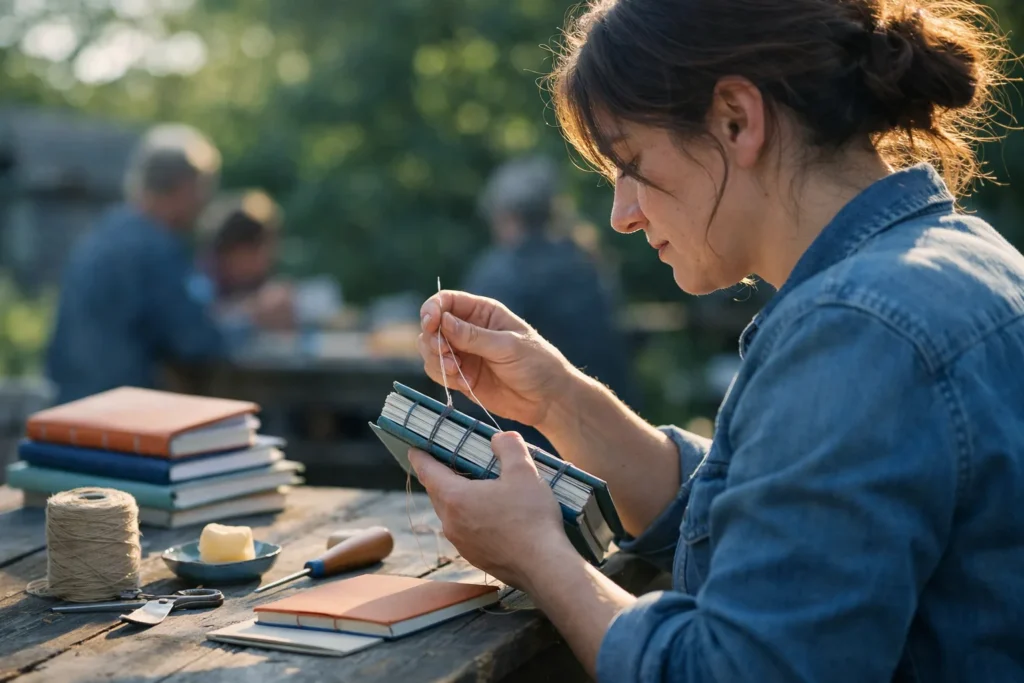
Of all the ways to bind a book by hand, Coptic stitch is the one beginners fall in love with. There is no glue, no press, and no special machine. The pages are sewn together with a chain of loops along the spine, and the finished book opens completely flat on a table, which makes it ideal for a sketchbook or a journal.
In weekend workshops in Columbus, Ohio, we start nearly everyone here, because the stitching is repetitive, forgiving, and easy to see. The technique is named after the early Christian communities in Egypt who used it, and you can read more about Coptic binding if you enjoy the history.
What you need
- Paper for the pages: 20 to 24 sheets of 8.5 by 11 inch paper, or any size you like.
- Two covers: pieces of thin cardboard or chipboard cut slightly larger than the folded pages.
- Waxed linen thread or any strong thread, about 4 feet (1.2 m) per two signatures.
- A curved bookbinding needle or a sturdy sewing needle.
- An awl or a thick pin, a ruler, a pencil, and a bone folder, or the back of a spoon for creasing.
Cover the table with a scrap board before you pierce anything. A thick magazine or a cutting mat works well.
Fold the signatures
A signature is a small group of folded sheets. Fold each sheet in half, crease it with the bone folder, and nest four to five folded sheets together. For a notebook of about 100 pages, make five or six signatures. Stack them so the folds line up on the left side.
Punch the sewing holes
Cut a strip of scrap paper the height of the spine and mark it with the sewing stations: one 0.5 inch (1.3 cm) from each end, and the rest spaced evenly between them. Four stations are plenty for a small book.
- Open a signature to its center fold and lay it in a V-shaped cradle, such as a folded towel.
- Align the marked strip along the fold and poke the awl through each mark, from the inside out.
- Repeat for every signature, using the same strip so the holes match.
- Punch matching holes in the spine edge of each cover, about 0.25 inch (6 mm) from the edge.
Sew the first signature to the cover
Thread the needle and tie a knot about 4 inches (10 cm) from the end. Stack the front cover, then the first signature, and bring the needle from the inside of the signature out through the first hole. Loop it around the cover, go back into the same hole, and continue to the next station. At each station, the thread goes around the cover edge.
When you reach the last hole, tie off the thread inside the signature with a small knot. Keep the tension even, and tight enough that nothing rattles, but loose enough that the paper does not tear.
Add the remaining signatures
Place the second signature on top of the first. Sew in through the end hole, and before you pull the thread all the way through, loop it behind the stitch in the signature below. This creates the characteristic chain. Move to the next hole and link it again. Do this at each station.
When you reach the end of the signature, tie it to the thread from the previous one with a square knot, then continue on to the next. Keep going until all signatures are attached, then add the back cover the same way you added the front.
Finish and tighten
After the last signature, tie a knot, trim the tails, and press the book flat under a heavy book overnight. Run your fingers along the stitches and pull the slack out of each chain. A good Coptic book feels firm but opens like a hinge.
If you are shopping for tools, see the shopping advice in our craft supplies and studio section before you buy specialty items. Most of what you need can be found at home or borrowed from a friend who sews.
Common mistakes
- Uneven holes lead to a crooked spine, so use the marked strip every time.
- Thread that is too short means you run out in the middle, so allow more than you think you need.
- Pulling the stitches too tight tears the folds. Pull until the thread lies flat, then stop.
Your first book will not be perfect, and that is part of its charm. By the second one, your stitches will be even, and by the third you will be planning covers in fabric or painted paper.