
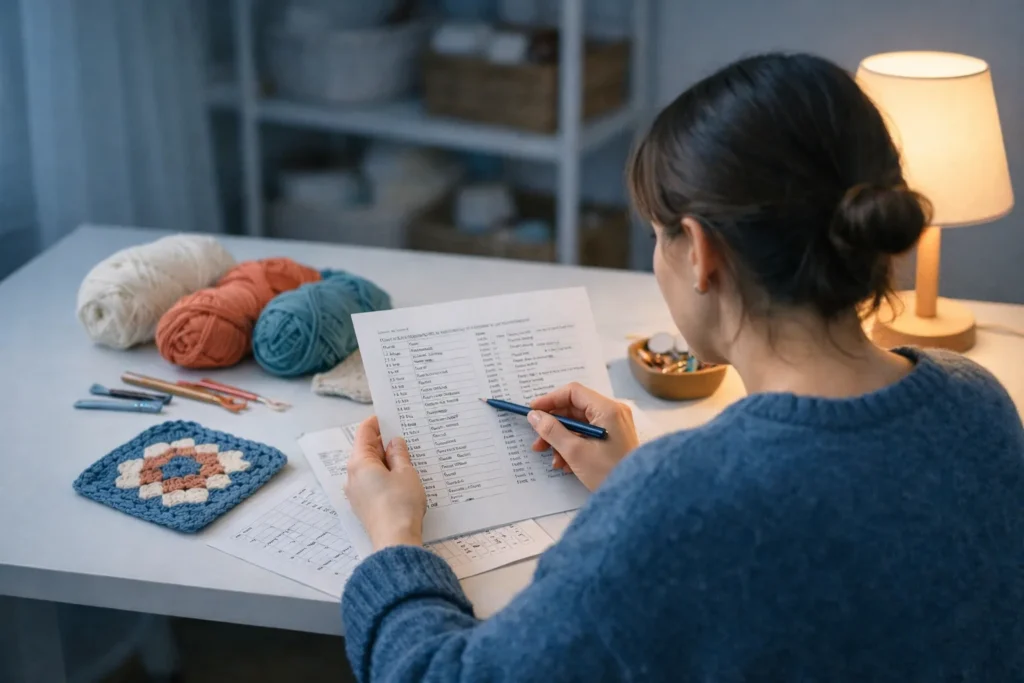
The first time you open a written crochet pattern, it can look like a password: Ch 24, sc in 2nd ch from hook, *dc in next 3 sts, sk 1 st; rep from * across. The good news is that nearly every pattern in the United States uses the same shorthand, and it takes about twenty minutes to learn the part you will see on every page.
Start with the standard abbreviations
Most American patterns follow the abbreviations and symbols published by the Craft Yarn Council, the trade group behind the Yarn Standards used on many yarn labels. Once you know about a dozen, you can read almost any beginner pattern.
- ch is a chain stitch.
- sl st is a slip stitch, used to join rounds or move across a row without adding height.
- sc is a single crochet, the short, dense stitch.
- hdc is a half double crochet.
- dc is a double crochet, the taller stitch that works up quickly.
- sk means skip a stitch, and st(s) means stitch or stitches.
- rep means repeat, rnd is a round, and tog is together, as in sc2tog.
Patterns usually list the abbreviations they use near the top or the end. Read that list first, because a designer may add a special stitch such as a shell or a puff and define it just once.
US terms versus UK terms
The same word can mean two different stitches depending on the country where the pattern was written. In US terms, a double crochet wraps the yarn once over the hook. In UK terms, the same stitch is called a treble. If a pattern uses an unfamiliar name, look for a note near the top that says whether it is written in US or UK terms. If you cannot find one, check the yarn and hook sizes: American patterns list inches and ounces, and hook letters such as I-9.
Decode the punctuation
The symbols matter as much as the letters, and they are where most beginners get lost.
Asterisks
An asterisk marks the start of a repeat. In the example above, *dc in next 3 sts, sk 1 st; rep from * across means you work three double crochets, skip one stitch, and go back to the asterisk and do it again until the end of the row. Some patterns use two asterisks, or a symbol like a dagger, to mark a second repeat.
Parentheses and brackets
Parentheses usually mean that you work every stitch inside them into the same place. For example, (2 dc, ch 1, 2 dc) in next st makes a shell in one stitch. Brackets often group a longer sequence that gets repeated a stated number of times, such as [sc in next st, ch 2] 4 times.
A number in parentheses at the end of a row, such as (24 sts), is a checkpoint. It tells you how many stitches you should have when the row is done. Count them. If your count is off, find the mistake now and not twenty rows later.
Check the gauge before you begin
The gauge line looks like this: 14 sts and 8 rows = 4 inches (10 cm) in dc. It is the designer’s promise about the size of the stitches, and it decides whether your finished piece will match the measurements in the pattern.
- Chain enough stitches to measure about 6 inches (15 cm).
- Work the stitch named in the pattern for about 6 inches (15 cm) in height.
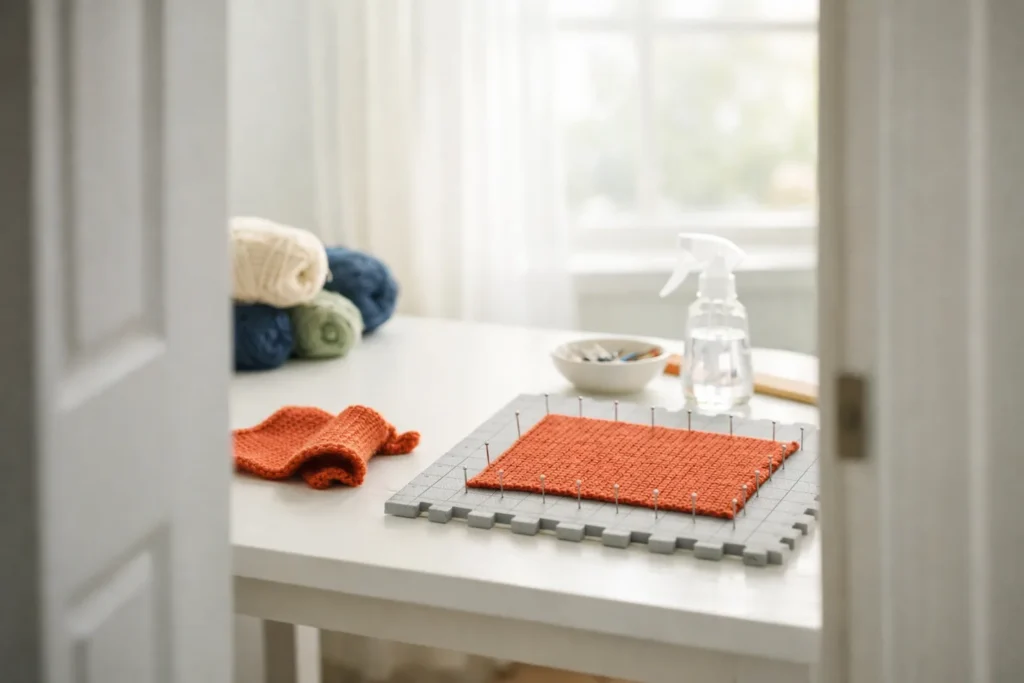
- Lay the swatch flat without stretching it, and count the stitches and rows inside a 4-inch (10 cm) square.
- If you have more stitches than the pattern calls for, move up one hook size. If you have fewer, go down one.
Swatching feels like a chore, but it is the difference between a hat that fits and a hat that fits a doll. A swatch for a blanket can be small, but a swatch for a sweater should be washed and measured again, because yarn changes after its first bath.
Read the whole pattern once before you start
Look at the materials list, which names the yarn weight and the hook size, then read the notes and the finishing section. A pattern may ask you to use a particular yarn weight in the category system of the Yarn Standards, which runs from 0 for lace to 7 for jumbo. If you plan to substitute another yarn, match that number and then swatch.
While you work, keep a pencil handy and tick off each row as you finish it. If your pattern is on a screen, use a sticky note or a row counter to mark where you are. Most mistakes come from losing your place after an interruption, and a simple mark saves you from guesswork.
With these few habits, the code turns into plain instructions. After your first two or three patterns, you will read ch 3, turn without thinking about it, and the abbreviations will become as familiar as the alphabet.