
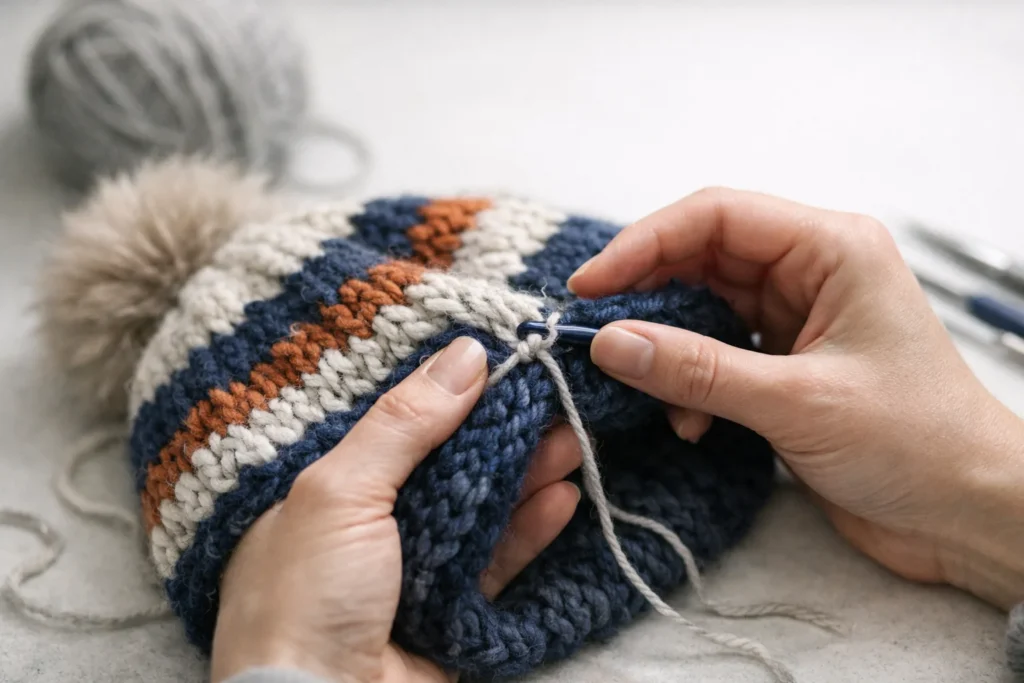
A hat worked in the round has a small flaw that most crocheters notice after a few rounds: a slanted seam running up the back, right where each round was joined. In a Maine winter, you will wear the hat for months, so it is worth making it tidy. The fix is not a special stitch. It is a way of joining and starting each round.
Why the seam shows
When you join a round with a slip stitch to the first stitch, then chain up to start the next round, the chain stands in for a stitch but looks different from the ones around it. Stack a dozen rounds on top of each other and the chains line up into a visible stripe. The tighter the yarn, the more obvious the stripe becomes.
Join the round without leaving a gap
- Work the last stitch of the round.
- Insert the hook into the top of the first stitch of that round, through both loops.
- Yarn over and pull through the stitch and the loop on the hook in one motion. This is the slip stitch.
- Do not pull the slip stitch tight. Keep it as loose as your other stitches.
If the yarn was thick or the hook was small, go up half a size for the join only. A tight slip stitch puckers the fabric and draws the eye straight to the seam.
Skip the turning chain, or hide it
Many crocheters use a trick known as the chainless start. Instead of chaining three at the beginning of a double crochet round, you pull up the first loop a bit taller and work the stitch into the base of the previous round. This leaves no chain, so there is nothing to stand out. If you prefer to keep the chain, work it very loosely and count it as a stitch only if the pattern says so.
Another approach is to move the starting point. Every few rounds, shift the join one stitch to the left or right. The seam then zigzags and blends into the fabric, and nobody can follow it with their eyes.
Mark the start of each round
Put a stitch marker in the first stitch of every round and move it up as you go. It keeps your stitch count right.
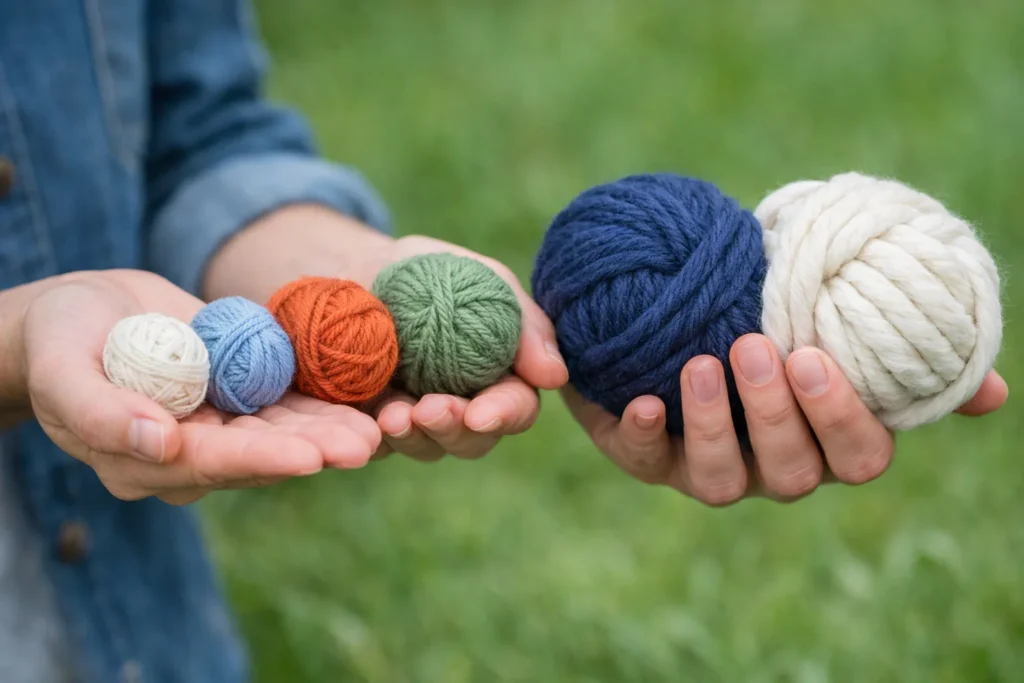
Check the gauge and the yarn weight in the Craft Yarn Council system before you begin, and choose a wool blend that suits cold weather. A category 4 medium weight yarn on a 5.5 mm hook is a common choice for a warm hat.
Finish the hat cleanly
At the top, cut the yarn with a 10-inch (25 cm) tail, thread it through the last stitches, and pull tight. Weave in the ends with a yarn needle.
With a loose join, a chainless start, and a shifting seam, the back of your hat will look as smooth as the front.