
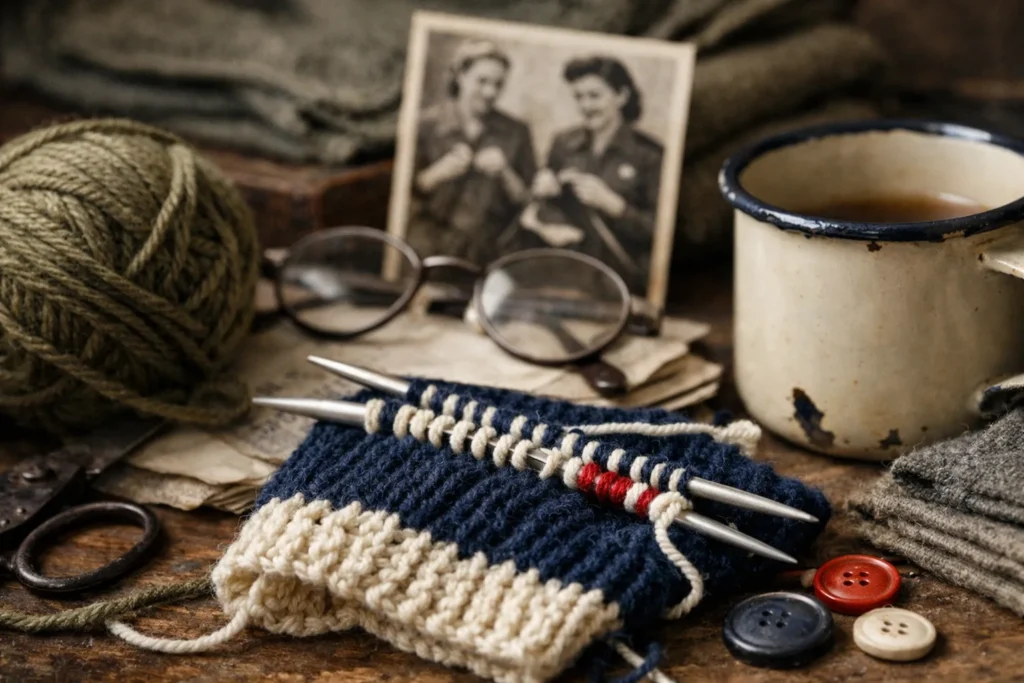
Few crafts carry as much American history in a single skein as knitting. In both world wars, millions of women, men, and children picked up needles to make clothing for people they would never meet. The collections of the Smithsonian’s National Museum of American History include items and records that show how ordinary this work was, and how organized.
Knitting as a war effort
When the United States entered World War I in 1917, volunteer groups across the country began making warm clothing for troops. Schoolchildren knitted squares for blankets, church groups held knitting afternoons, and newspapers printed patterns. The idea was simple: every household could contribute something useful, and the work could be done in the evening, at a kitchen table.
The same spirit returned in World War II. The American Red Cross distributed knitting patterns and wool to volunteers, and the items most often requested were socks, sweaters, scarves, caps, and gloves. Many of those patterns were deliberately plain, written so that a beginner could finish a pair of socks without a teacher.
Knitting for the troops was one way civilians took part in the war effort at home, with volunteers turning out socks, sweaters, and caps from patterns distributed through organizations such as the American Red Cross. — Smithsonian Institution, paraphrased from its collections on home front knitting
What the patterns looked like
Wartime patterns are a good reminder of how little a pattern needs to say. A typical sock pattern gave a few numbers for cast on, a ribbed cuff, a heel flap, and a toe decrease, and it assumed the knitter already knew how to turn a heel. The yarn was heavy, often a dark wool in navy, olive, or gray, because it had to be warm and hard-wearing.
Some patterns avoided features that could cause blisters, such as bulky seams. The helmet liner and the watch cap, a simple knit hat that rolls up at the brim, became standard projects because they used little yarn and fit almost anyone.
Many of those patterns are now in the public domain, and you can find reproductions in libraries, local historical societies, and museum shops. When you use one, check the yarn weight and needle size against modern labels, because old gauges do not always match today’s yarns.
What to take from this for a gift today
You do not need a war to make a useful handmade gift. A few lessons from the home front still work well today.
- Keep the pattern simple. A plain ribbed hat or a basic scarf is easier to finish than a complicated sweater, and it is more likely to be worn.
- Choose durable yarn. A wool blend or a machine-washable fiber will survive daily use, so check the label.
- Make it in the person’s color. A solid navy or charcoal goes with nearly everything.
- Add a short note. Even a line about when and where you knitted it makes the gift personal.
A pair of socks is the classic wartime project, and it is still a lovely gift. Use a fingering or sport weight sock yarn, which is easy to find and holds up to wear, and plan for a pair of roughly 8 to 10 hours of knitting. A hat takes a weekend.
Knitting for others, today
The tradition has not disappeared. Many local groups, libraries, and community centers knit hats and blankets for hospitals, shelters, and veterans’ organizations. Before you make anything to donate, ask the group for its guidelines: they often specify the fiber, the size, and the colors they need. A call or a visit saves you from knitting something that cannot be used.
Handmade work connects people across time. The knitters of the 1940s could not have known who would wear their socks. You can use the same generosity for a hat that keeps a neighbor warm this winter.