
Florida summers can push indoor relative humidity well above what craft materials like. Damp air makes paper wave, lets mildew creep onto natural fibers, and thickens or spoils some paints. The fix does not require special equipment, but it does require airtight containers, a few moisture absorbers, and a habit of checking your stash.
The University of Florida’s IFAS Extension, which serves the state’s households with research-based advice, regularly covers mold, moisture, and pests in the home. Its guidance on humidity control is a good starting point for any storage plan. Many conservators and extension specialists suggest keeping indoor humidity below roughly 60 percent, and a small hygrometer, a few dollars at a hardware store, tells you where your room actually stands.
| Material | Risk | Best container | Check how often |
|---|---|---|---|
| Wool and natural-fiber yarn | Moths, mildew, musty smell | Airtight plastic bin with a desiccant packet | Every 2 to 4 weeks |
| Acrylic and synthetic yarn | Dust, occasional mildew in damp spots | Lidded bin or zip bag | Monthly |
| Paper and cardstock | Curling, warping, mold spots | Flat plastic box with a tight lid | Monthly |
| Finished artwork on paper | Foxing, sticking, discoloration | Acid-free folder inside a sealed box | Every 1 to 2 months |
| Acrylic paint tubes and jars | Skin forming, lid sticking, separation | Closed container in a cool closet | Every 2 months |
| Brushes | Mildew, bent bristles | Upright in a dry jar, or a ventilated brush roll | Monthly |
Yarn
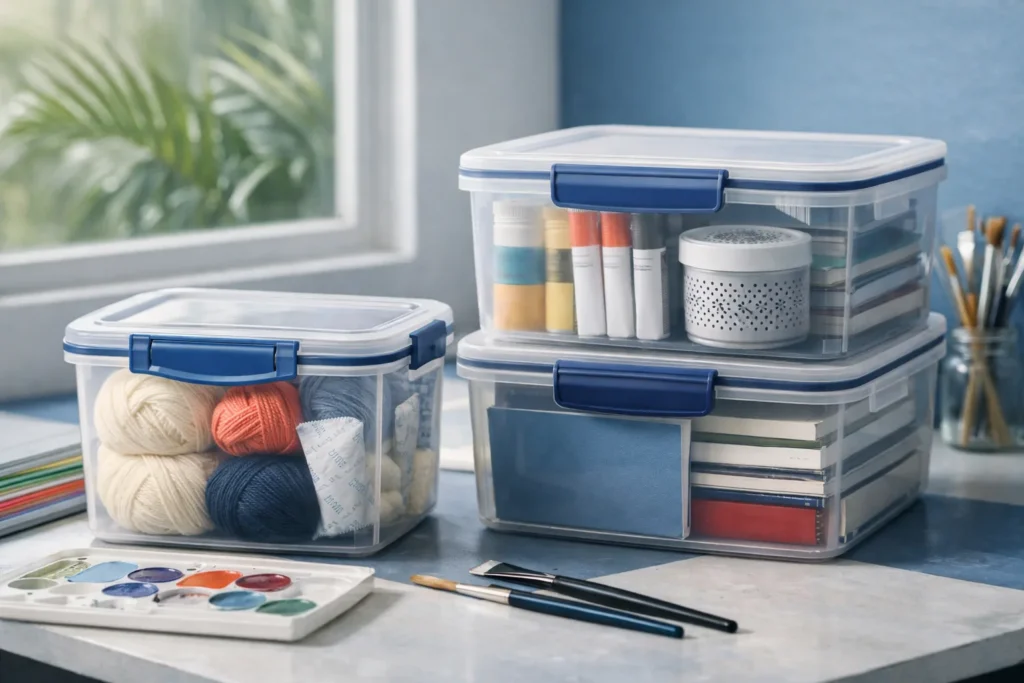
Wool and other natural fibers hold moisture, which invites mildew and moths. Wash and fully dry yarn before you store it, and avoid putting away anything that smells musty. Use airtight bins, not cardboard boxes, which absorb humidity from the air. A silica gel packet or a small tub of desiccant in each bin soaks up leftover moisture. Cedar blocks may discourage moths, but they do not replace an airtight lid. If you find a moth or small holes, isolate the bin right away and freeze the yarn in a sealed bag for a few days to kill any eggs, then wash it.
Paper
Paper takes on moisture from the air and swells unevenly, which causes curling. Store flat, in plastic boxes with lids, and keep the box off the floor, where humidity can be highest. Place a desiccant packet inside, and replace or recharge it as directed. For artwork you care about, use acid-free folders and tissue. Avoid storing paper in the garage or an unair-conditioned shed, where it can get damp and attract insects.
Paint
Acrylic and watercolor tubes tend to hold up well if the cap is clean and tight. Wipe the threads before closing, store tubes upright or flat in a plastic box, and keep them where the temperature stays stable. Mold can grow in watercolor pans left damp, so let them dry open before you close the lid. Do not store paint where it can freeze or bake.
A simple Florida routine
- Put a hygrometer in the craft room and read it once a week.
- Run the air conditioning or a dehumidifier whenever readings stay high, especially during summer.
- Keep bins off exterior walls and floors where moisture collects.
- Replace or recharge desiccant packets on a schedule.
- Check each container with your nose as well as your eyes. A sharp, musty smell is the first sign something is wrong.
The University of Florida IFAS Extension offers practical publications on mold and moisture that go further than this guide. If mold has already taken hold on something valuable, let it dry fully, brush it outdoors with a soft brush while wearing a mask and gloves, and consult a conservator for irreplaceable pieces. People with asthma or mold allergies should ask a doctor before cleaning.
For ideas on building shelves and wall storage, see painting and drawing for how others organize brushes and tubes in small spaces.