

The cardstock aisle can feel like a puzzle. One pack says 65 lb, another says 110 lb, and a third lists a number in grams. If you want to make cards, tags, boxes, or paper models, knowing how to read these numbers saves you from buying sheets that jam your printer or crumple under a fold.
What a pound weight means
In the United States, the weight printed on a package of cardstock is the weight of a ream, which is 500 sheets, in its original large size before it is cut down to letter size. That is why a 65 lb sheet of cardstock does not weigh 65 pounds, and why the number looks big. Different types of paper use different base sizes, so you cannot compare a pound number from a cover stock to a pound number from a bond paper directly.
Outside the United States, most paper is described in grams per square meter, or gsm, and sized under the international ISO 216 system, whose best-known size is A4. American letter paper, at 8.5 by 11 inches, follows standards from the American National Standards Institute, which is why the two systems never line up exactly. For a general overview, see the article on paper sizes.
When you see both numbers on a package, use the gsm figure to compare brands. It is the only number that is directly comparable.
The common weights compared
| Weight | Thickness | Best for | Printer-friendly |
|---|---|---|---|
| 65 lb cover (about 176 gsm) | Light, roughly 0.009 in | Scrapbook backgrounds, simple cards, templates | Yes, in most home printers |
| 80 lb cover (about 216 gsm) | Medium, roughly 0.011 in | Greeting cards, tags, pop-up bases | Usually, through a rear feed |
| 100 lb cover (about 270 gsm) | Heavy, roughly 0.014 in | Invitations, sturdy folders, book covers | Sometimes, check your printer manual |
| 110 lb cover (about 300 gsm) | Very heavy, roughly 0.015 in | Boxes, models, stencils, die-cut shapes | Rarely, and often not at all |
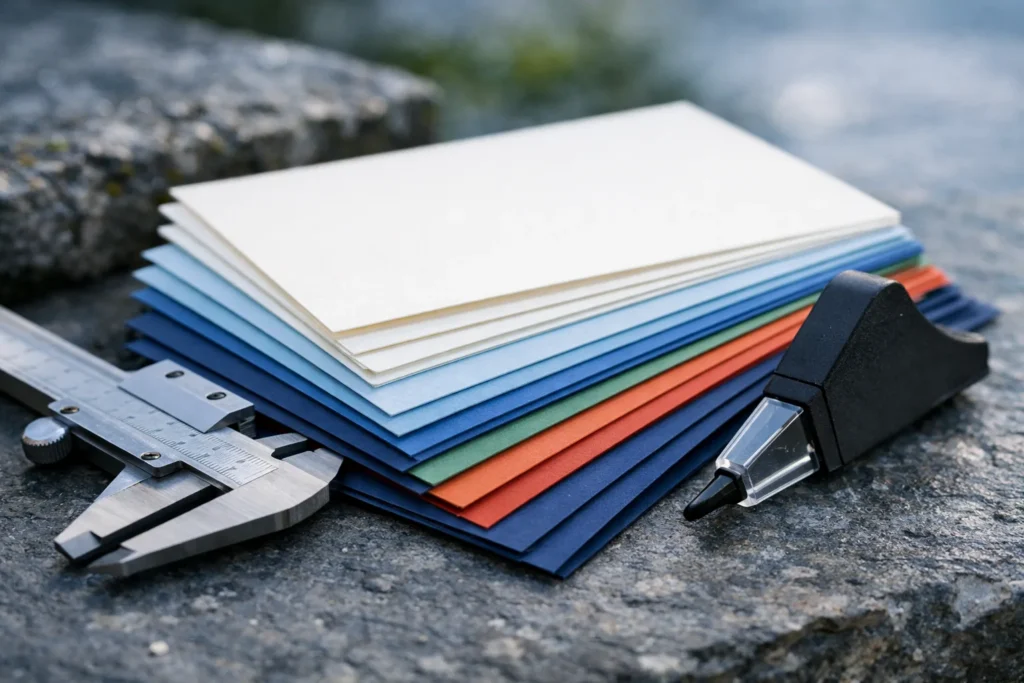
These thickness values are approximate and differ between makers. If a number really matters, measure a sheet with a ruler or a caliper.
Match the weight to the project
A greeting card that stands on its own needs at least 80 lb. A pop-up card with moving parts does best with a base of 80 lb and details cut from 65 lb. For a box that needs to hold its shape, use 100 lb or more, and score the folds before you bend them.
If you plan to cut the shapes by hand, remember that heavier paper tires your fingers. A craft knife and a metal ruler help, and a hole punch with a long handle makes light work of thick sheets.
Will it fit in the printer?
Home printers have limits. Many inkjet and laser models accept paper up to about 65 to 80 lb, and some tolerate more through a rear or manual feed slot. Check the manual for the maximum weight or thickness, and test with a single sheet before you load a whole stack.
- Use the manual feed tray whenever you can, because it keeps the sheet flatter.
- Feed one sheet at a time, even if the tray allows more.
- If the printer smears or jams, switch to a lighter sheet and glue two layers together instead.
Smart ways to buy
Buy a small mixed pack first, so you can feel the differences. A sample of 65, 80, and 100 lb in the same color tells you more than any chart. If you plan to make many cards, a larger ream of the weight you used most is cheaper per sheet, but only after you know you like it.
Store cardstock flat, in a dry place, and out of direct sun. Paper absorbs moisture and curls, which can ruin a stack in a humid room. A shallow box with a lid is enough for most hobbyists.