
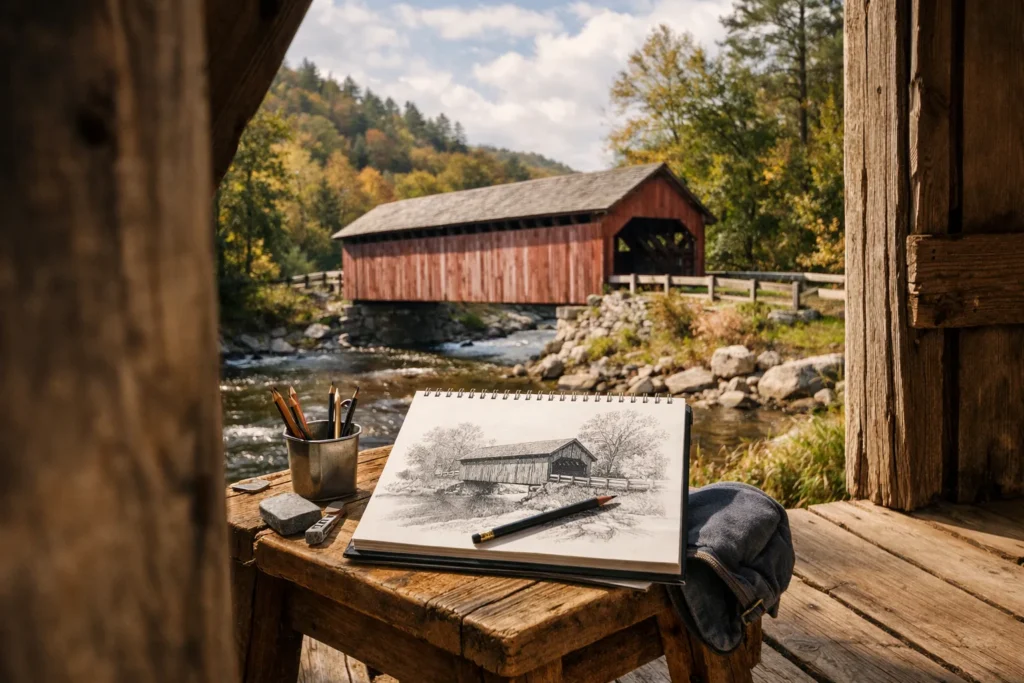
Vermont is dotted with historic covered bridges, and the Library of Congress holds photographs and measured drawings of many of them. That archive is a handy reference when you cannot stand beside a real bridge. The shape also happens to be a gift for beginners: a long box, a pitched roof, and a dark opening that pulls the eye straight into the picture.
All you need is a 2B pencil, a pocket sketchbook with paper heavy enough to take an eraser, and a kneaded eraser. A 2B lead is soft enough to give you a rich gray without smudging the way a 6B does. Sharpen it to a long point, then keep a small piece of scrap paper nearby for testing the tone before it touches the page.
Step 1: Find the horizon and the vanishing point
Before you draw the bridge, draw a light horizontal line across the page, roughly a third of the way up from the bottom. This is your eye level. Mark a dot on it, a little off center, to be your vanishing point. Every line that runs away from you along the length of the bridge will aim toward that dot.
If you are sketching from a photo, hold a pencil flat against the roofline and see which way it tilts. You are looking for the angle, not the detail. Copy the angle onto your page with a faint line and move on.
Step 2: Block in the big box
Draw the near end of the bridge as a simple upright rectangle. Then run two light lines from its top corners toward the vanishing point, and two more from the bottom corners. Close the far end with a smaller vertical line. You now have a long, shrinking box.
- Keep every line pale. You will erase half of them.
- Make the bridge about twice as long as it is tall if you want it to look stocky and traditional.
- Check that the verticals stay vertical. Tilted walls make the bridge look as if it is sliding off the page.
Step 3: Add the roof and the portal
Place a shallow triangle on top of the near end for the gable. The roof should overhang the walls by a thumb’s width or so, which casts a useful shadow later. Carry the roof lines back toward the vanishing point just as you did for the walls.
Next, draw the arched or squared opening at the near end. Make it about two thirds the height of the wall. Inside it, sketch the dark interior with a few vertical lines for the timber framing. Leave the opening almost empty for now.
Step 4: Shade with the side of the lead
Decide where the light is coming from and stick with it. If the sun is on the left, the right side of the roof, the right wall, and the inside of the opening are in shade. Lay the pencil nearly flat and stroke in one direction, building gray in layers instead of pressing hard.
Vertical boards on the siding can be suggested with a handful of straight lines rather than every plank. Squint at the scene: if a detail disappears when you squint, it probably does not need to be in the sketch. Darken the opening last, because it should be the deepest tone on the page.
Step 5: Ground the bridge and clean up
A bridge floating in white space looks unfinished. Add a few horizontal strokes for the stream below, a quick suggestion of the abutments, and a handful of loose, scribbled tree shapes behind the roof. Lift small highlights out of the shading with a kneaded eraser pressed (not rubbed) onto the paper.
Then step back, hold the sketchbook at arm’s length, and check the values. If everything is the same medium gray, push the darks darker. Contrast is what makes a pencil study look confident.
Keep it pocket-sized
Small sketches add up. Try three thumbnails of the same bridge, five minutes each, from different angles before you commit to a larger drawing. If you want to loosen up first, the seasonal and kids’ crafts section has easy projects that warm up your hands. For historic reference material, browse the photographs at the Library of Congress, then compare your own proportions to the originals.